
After over 3 years of regularly blogging, we have finally gotten round to upgrading the look of our own blog. We would love your feedback, so if you like it (and even if you don’t) please drop us a line.
Look who is going Places in Project Marketing (our recent newsletter)

This month Brightfox is proud to introduce Brisbane based project marketer, Place Projects.
In the last few months Place Projects have not only adopted foxEnterprise to manage the sales, marketing and reporting functions for their project sales but have also released a brand new website with a custom design by Brightfox utilising the power of the Umbraco Content Management System.
 The Place brand launched onto the Queensland residential real estate scene in late 2002 and since then has grown significantly in both recognition and in market position.
Real Estate power houses – Bruce Goddard, Syd Walker, Damian Hackett and Lachlan
Walker partnered with this growing name, to open the Place Projects office. Understanding that their project marketing needs were going to be immensely more complex than a residential sales office, they approached Brightfox looking for a high quality CRM system and a website that could keep up with the times.
The Place Property group had an existing in-house CRM software application in use
throughout their offices. But to suit their specific project marketing needs
Place Projects spent a considerable amount of time investigating the various
options available on the market before deciding on foxEnterprise and according
to Kathy Cuthbert of Place Projects.
“. . . We never found a system before that catered for
projects. . . and the system is amazing and so user friendly”
and 3 months down the track…
“Since using foxEnterprise we get help with anything
we ask for and if it can’t be fixed straight away or the
person we speak to can’t help us, any issues
arenormally resolved within 24hrs.”
Place Projects is a business involved in launching and marketing
new ‘off the plan’ Projects, so it was essential that the website presented the
Company and the Projects it was marketing professionally. The website needed to
be user friendly and be easily updated, with both new Project content but also
up to date research from Place Projects own internal research division.
The Place Projects website has been built from the ground up to work
seamlessly with foxEnterprise, ensuring that all prospects are imediately
captured and profiled for each Project within the foxEnterprise CRM. The
Brightfox CMS (Content Management System) ensures that Place Projects is 100% in
control of the content on their website, updating as they need to, thereby
ensuring it’s up to date and encouraging repeat visitors to the site.
and the results… 
“We had our projects website designed and operational within a couple of months, the training for it was great and even now, when there is a question it’s answeredin no time at all. It’s so user friendly we can make 99% of the change ourselves”
Changes to Google Search Algorithm – will it affect real estate
Google have just announced a major change to the way they their search works. Basically the changes are designed to ensure more current information is given priority in search results.
Sounds like a good idea, particularly if they can deliver updates (as they suggest in their article) within minutes of publication on the web.
So what relevance would this have for real estate online?
I immediately thought of Auctions. I wonder is this is smart enough to grab upcoming Auctions only and display the relevant page data.
So I went and did some simply searches a few minutes ago. Below you can see the results from a search on keywords ‘property for auction in bulimba’.
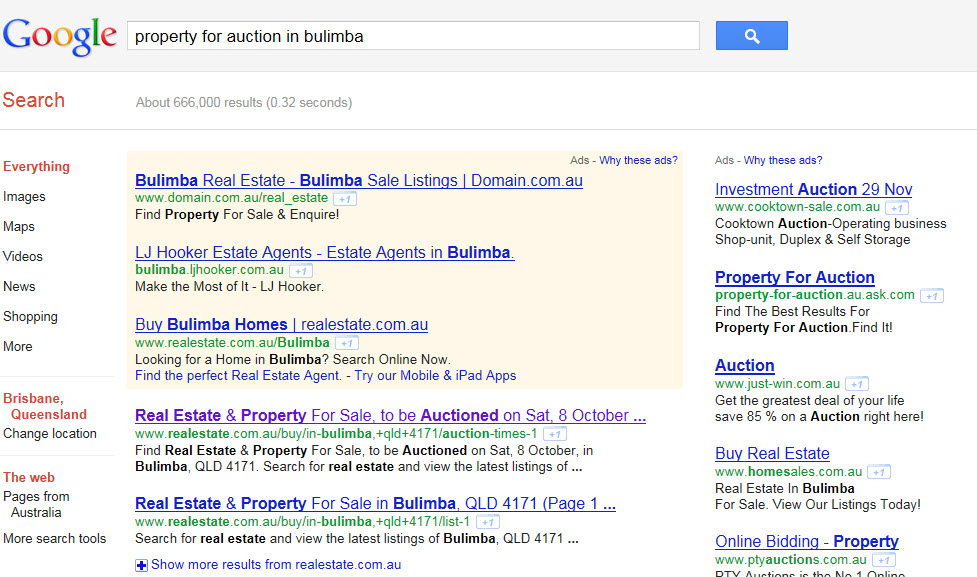
As you can see the first line item is a realestate.com.au link with a heading refering to Sat, 8 October. Not a good start. The link itself works fine. The REA site is smart enough to link me to Auctions coming this Saturday, but that is not the point here. The point is is that the Google Algorithm change was not smart enough to figure out that the data in their data (the heading and summary) was less relevant by date them other data.
Going further down the results we get bettter results though. See the www.domain.com.au record for the auctiopn due on 24th November.
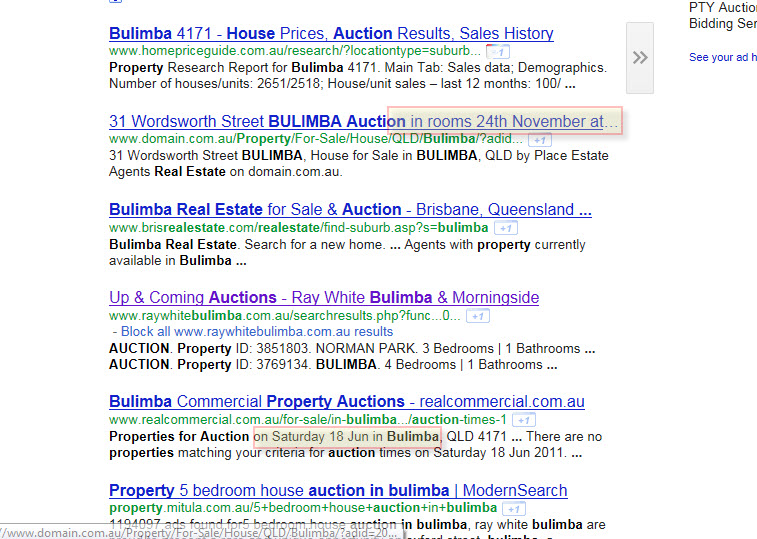
Further down the results though you can see another entry for 18th June.
So all in all what has changed? Hard to say as I did not run this search yesterday before they ran the upgrade but certainly from an Auction search results perspective not great results.
Customer Relationship Management (CRM) and Impeccable Customer Service!
Not long ago we talked about the importance of implementing CRM systems. As a winner in your industry, I hope you critically analysed your own processes and the available products out there and took immediate action.
This week we will be following up on the topic and adding to it, just like a builder will add the walls on top of a solid foundation for a multi-storey building.
Let’s take two stories as an example:
1. Buying a Luxury Car – When you go to test drive a luxury car, let’s say a Jaguar or something similar, a good salesperson will be asking questions to get to know you; to get an understanding of who you are, what you like and more importantly what you don’t like, so that he / she can utilise this knowledge to persuade you to buy that expensive but lovely car. One sales agent I know of asks the question: What kind of music / artists do you like? When you do purchase the vehicle and return to the dealership to pick-up your new car, a stack of cd’s with all your favorite music is waiting for you!
2. Le Meridien Hotels – one of the well known, luxury hotel chains, has a unique service to ensure their clients always return to their hotels, anywhere they go in the world. So how do they get their clients to be so loyal? When you first go to one of their hotels they ask you a bunch of questions, silly things like what kind of pillows do you and your partner like (feather, downe, etc), how you like your eggs, do you like orange juice or apple juice, how do you take your coffee, etc. Silly questions right? Well, should you choose to stay with Le Meridien again, no matter where in the world you stay, when you walk into your room you will have your favourite pillow on the bed and when you wake up, your breakfast in bed will consist of your eggs prepared the way you like them, alongside your preferred morning drink, etc.!
Now the simple question you may ask, as a fellow salesperson, is how in the world did they know all this information and remember it? I can’t even remember a person’s name, let alone his / her partners name or where they work, let alone their kids’ names!
Well let me tell you that this is where the best salesperson leaves the rest trailing behind.
Just imagine, you maintain as much information about your prospective buyer or seller and even if they don’t do business with you now, you keep in touch with them (via email marketing as discussed in one of our earlier blogs) and when they do come to discuss their options with you in a year or two, you’re able to say:
“Hi Paul & Wendy! How is [insert kids names here]? Are they still at [Name of school]? Etc. And did you get my [Birthday Card /Anniversary of Purchase Letter]? . . .”
If I talked to you like that, would you feel a rapport between us? Would you like to do business with me? I hope you say yes!
How do you achieve this in your business?
Step 1: Build a strong foundation for your business with a good real estate specific CRM system.
Step 2: Capture the Data! You will need a process where you are able to capture the required information while you are on the move. This can be achieved by a paper based form which you fill out as soon as you have spoken to a prospect (buyer or seller). This information can be entered into the CRM by yourself or by your PA so as to maintain the accuracy of your CRM system.
Step 3: Implement the process. Time and again we have seen many agencies implement a fancy CRM program and even design a very good system but do not follow through. This is where your CRM supplier has to play an integral part to coach / consult with you to ensure the implementation is successfully carried out over the first 90 days. As soon as the Agency has been using the system continuously for over 90 days, it becomes second nature and the chances of falling back to the old ways of doing business will be reduced.
A Quick Brightfox Plug!
Brightfox is one of the world’s leading providers of CRM software and online marketing solutions for the property industry. We have a suite of software applications to suit individual agents, small, medium and large agencies, multi-office agencies, property developers, investment networks and retirement village developers and managers. We would welcome the opportunity to show you how we can help your busines, so please do not hesitate to contact us.
Action Plan:
• If you have not finalised a CRM system as yet, please do so. And when you are talking to your supplier, please enquire on whether they provide a consulting / coaching system to ensure successful transformation of your business processes.
• Decide on what kind of information that you would like to obtain from your prospects (buyers / sellers) and put it in a form / CRM • Start collecting information today!
• Put a plan in action for sending cards to your prospects / clients for birthdays, anniversaries, etc.
As always, please let us know your feedback on this or any other idea, as your feedback helps us to continuously improve these strategies. And don’t forget to pass these insights on to your friends / colleagues and help share the success!
Understand your clients and communicate better!
In previous blogs we have talked about how you can keep track of all your past customers and the people you meet every day.
In this blog we will look at trying to understand what they want!
There’s no point in you having boxes and boxes of business cards from as far back as 1989 if you have no clue where you met the people they belong to, what you discussed with them and what they were looking for.
I hope after reading and taking action on our last few posts, you will no longer have boxes of business cards, or excel spreadsheets filled with people’s names and contact details. I am sure you will have pulled the plug and done some research and implemented a specific CRM system for your business.
Now let’s look at segmenting these people into manageable sections.
- Some of these people might have talked to you about buying their first home.
- Some of them may have said that they can only afford to buy for less than $450K.
- Some of them might have said that they already have 3 properties and may be looking at buying some more or may even be selling 1 or 2, if the price is right.
- Some of them might just be local business leaders you met at the Chamber of Commerce and they may even consider referring new business your way, etc.
Can you see where I am going with this? When you add a new person into your CRM system, you will need to have thought through which category or categories that person will fit into. This is going to be extremely effective when you send out targeted marketing materials.
Now why do you need to send out targeted emails as opposed to just sending the same emails to everyone?
Well, as the saying goes, even if you get the highest quality Grade A steak lovingly cooked by a world renowned chef, when you put it in front of a vegetarian he or she is still not going to eat it. Are they?
The same applies to your prospects as well. If you keep sending email messages that are not targeted to what they want, they are going to see you and your marketing material to be more of a nuisance/spam rather than a helpful service provided for their benefit.
This simple point is extremely vital for your success (online or otherwise) and that’s why we take great care and spend hours working with our clients to see how they want to segregate/categorize their customers/prospects/etc, to effectively market and get more business.
For example, one of our client’s categorised their prospect list as follows:
- Buyers under $350K.
- Buyers between $350 – 500K, etc.
- Buyers for apartments with ocean views.
- Buyers for apartments close to ocean views, etc.
What we have seen and learnt from the best agent’s is that they have a system that they follow without fail, especially when it comes to adding new prospects to their database, segmenting them and marketing to them on a regular basis.
All we are recommending is for you to refine your system or create a new system that will help you convert this routine task into a habit, just like you have converted the activity of driving a car into a habit.
One of the additional benefits of categorising your database is that it will be a fantastic marketing tool for you to get more listings.
Imagine this, you get a call from a prospective vendor and they say, “I am looking to list a property with ocean views”. Now, even before you start talking about anything else, all you need to do is jump into your categories and check the number of people who are in your database specifically looking for this kind of property. And you tell the vendor, I have just over 175 people looking for your property.
Will that make them want to list with you or walk down to your competitor who says, “we have a database, but we don’t really know exactly how many are looking at something similar to your property”?
When the vendor lists with you (which invariably happens to quite a few of our customers, as they have the right data at their finger tips) the first thing, even before advertising or putting it on realestate.com.au, is to select everyone in this category and send out hundreds or even a thousand emails to your database of buyer’s who are looking for that exact property. Just imagine how fast the property will be sold!
Action Plan:
- Go through your last 12 month’s sales and see what kind of categories/segments you can create
- Implement these into your CRM and go through the list of people in your CRM and categorise them. If you don’t know which category a prospect/client falls into, then it’s a good time for you to give them a call to chat and understand what they are looking for. If the number of calls you need to make is huge, get your assistant or hire temporary staff to call and update this information as this will be extremely valuable in the current market.
- Develop a Customer Registration Form and carry them in your folders and give them to your entire team so that they can get as much information they can from a prospective buyers anytime.
If you haven’t looked at our CRM systems as yet, I urge you to contact us for an obligation free online demo.
As always, please let us know your feedback on this or any other idea, as your feedback helps us to continuously improve these strategies.
Brightfox Plug!
Did you know that Brightfox not only develops some of the leading CRM solutions for the property industry, but also has their own award winning web design team that can help you market yourself and your business more effectively online.
Never Lose Another Client Again!
Recently we have been talking about the importance of communicating on a regular basis with your client database. The question that we want you to think about this week is, how many names do you have in your database and how often do you add to that list?
In the last 12 months how many people did you meet or talk to on the phone? Stop and think about the approximate number.. Is it 100 or is it more like 1000 + +.
Online marketers love to talk about how the money is in the list. What do they mean LIST? It basically means the list of prospects / clients that you have in your database. So in your career as a Real Estate Agent, how many people have you meet, and are they all in your list?
We know that in most developed counties people move houses every 5 to 7 years. So if you meet me today and we talked about buying a home, then theoretically by 2016, I will do the following:
– Buy a home
– Sell my home
– Buy another home
So in theory, you could possibly be involved in up to 3 transactions with me over the next 7 years. Now that does not include
– Any investment properties that I may buy.
– Any family and friends that I may recommend to you.
So let’s say you have 1,000 people in your list, who you keep in touch with regularly with valuable information: you know what they want and they know who you are. Now let’s say that you got 10% of their business as outlined above, then your settlement list will look like this by 2016:
3 x 1000 x 10% =
300 settlements in 7 years, that’s approximately 3-4 settlements every month!
That is the foundation of a very solid and successful business.
Now the question is, do you have all these 1000 + prospective customers details and have you kept in touch with them?
If you are not already doing this, what are you going to do to get started?
There are many different ways you can maintain this list:
1. On pieces of paper / sticky-notes !!
2. Outlook
3. On excel spreadsheets
4. Generic CRM software. You may have heard of ACT, Goldmine or similar off-the-shelf software.
5. Real Estate specific CRM software
What is CRM Software?
Definition: Customer Relationship Management (CRM) software is a way for you to capture every lead, purchaser, seller, service provider and other contacts that you deal with on a daily basis. It then enables you to systematically communicate with all or select contacts very easily by email, phone, mail, the web or sms.
It will transform the way that you sell, increasing sales whilst lowering the cost of sale, improve customer service standards and protect your business when
key staff leave.
Action Plan:
1. Review your current CRM / Database system
If you already have a CRM system that you are using, identify if you are using
the system to its full capacity and if you need further training to make
better use of it, then organise that. If you can’t get it working the way
you want, you might need to consider changing software and suppliers.
If you don’t have one – identify that you want to implement Real Estate
specific CRM software. Research the software out there in the market (Choose
one that is easy to use and gives you the functionality you need. It is
important to list for yourself exactly what you want to achieve from the CRM
software and then use this to compare the various options available).
2. Set up your existing contacts. We suggest that you focus on quality and not quantity. That is put into your database people that you have meaningful relationships with and will welcome communication from you. Don’t import old databases from prospects 10 years ago that you have never spoken with since.
3. Send out your first email to all your contacts / prospects / customers / past customers. You can use the templates you have already downloaded from our previous blogs. I think you will be pleasantly surprised at the response you will get from even your first email.
As always, please let us know your feedback on this or any other idea, as your feedback helps us to continuously improve these strategies.
A Quick Brightfox Plug!
Did you know that Brightfox is one of the world’s leading providers of CRM software and online marketing solutions for the property industry. We have a suite of software applications to suit individual agents, small, medium and large agencies, multi-office agencies, property developers, investment networks and retirement village developers and managers. We would welcome the opportunity to show you how we can help your business, so please do not hesitate to contact us.
Population Growth No Longer Qld’s Saviour Says Midwood
Below I have copied in the contents of an email from Alan Midwood promoting his new Midwood Report. It is a great and very indepth analysis of the Qld economy and very valuable reading for any involved in Tourism or Property Sales in Qld. The content of the email alone is well worth a read alone and it is reproduced below.
Population Growth No Longer Queensland’s Saviour

With net interstate migration down to under 10,000 per annum in Queensland (it has been as high as 52,000 per annum historically), and the cut in overseas migration, the state’s population growth rate of 2.5% per annum over 2005-2010 is likely to fall below 2.0% per annum over 2010-15.
Some would say that this is a good thing (Treasurer Andrew Fraser already has) so as to give some breathing space for infrastructure to catch up. If the State Government privately believes that a slowdown in population growth will be good for us, then there needs to be another driver of the state economy in the major cities, which do not benefit from mining.
Employment in Queensland remains our weakness and what we need is incentives, not disincentives, to employ people. Payroll tax is an obvious target and should be abolished. It is an old chestnut that Labor has never addressed. All stamp duty on residential housing transactions should also be abolished. Construction is one of the largest employment sectors in Queensland, mines included, and has huge multiplier effects throughout the economy.
A tourism marketing levy should also be introduced (taxed on the users, not facilitators) to fund more promotion and marketing of our state. Fiscal policy can be used to stimulate certain sectors of the economy but it is virtually non-existent in Queensland these days. It should be a key policy target for Campbell Newman’s “Can do Queensland”.
For a full list of permanent resident growth figures in selected Queensland localities, and independent commentary, see the latest edition of the Midwood Report here.
Queensland New Apartment Sales Stagnant but Brisbane Shows Confidence

The latest Midwood Report confirms that unconditional sales of new apartments in Queensland remain stagnant. For the three month period ending 31 May 2011, total unconditional sales for new apartments in the state’s major growth regions totalled 405, compared to 464 in the same period a year ago. Sales of new high-rise apartments were particularly sluggish with Gold Coast recording 51 unconditional sales and Brisbane, 189 sales.
The majority of Gold Coast sales, albeit at a low volume, have been for discounted receiver stock, for example in Southport Central III, which recorded 50% of all sales on the Gold Coast during the quarter. The historical long-term average for the Gold Coast is 300 unconditional sales per quarter.
The Midwood Report’s quarterly survey confirmed that Gold Coast apartment stock levels also continue to decline. As at 31 May, just 695 new apartments remained for sale, representing approximately two years supply at current take-up rates. New apartment supply on the Gold Coast has tightened because virtually no new stock has been released to the market since early 2009.
The Brisbane market, however, is confidently producing new stock with a net gain of 578 new apartments added to the report’s survey in the May quarter. The Brisbane market has been characterised by a sustained level of sales over the past two years, averaging 200 sales per quarter and this has brought overall unsold high-rise stock levels to 1,683 apartments as at 31 May, equivalent to 2.5 years supply at average take-up rates.
According to the Midwood Report, 95% of new, unconditional high-rise apartment sales in Queensland were recorded either in Brisbane or the Gold Coast in the May quarter. In regional cities such as Cairns and Townsville, just 45 sales were recorded together in low or medium-rise projects in the May 2011 quarter.
The general low level of sales volumes for high-rise, medium and low-rise apartments is not likely to improve until interest rates fall to a level which results in attractive returns to investors.
The comprehensive Midwood Report New Apartment Sales survey (Gold Coast to Cairns) is available only by subscription via www.midwoodaustralia.com.
Dwelling Approvals Hit Lows

Dwelling approvals across Queensland’s major growth regions have generally fallen to 2000-01 levels which coincided with the introduction of the GST.
Gold Coast house approvals are the lowest since 1993 and have been declining over the past three half-year periods and unit approvals are particularly low in this region compared to past years.
Brisbane house approvals are not so low compared to the Gold Coast, and unit approvals have held their past levels.
Townsville, Cairns and the Whitsundays have had declining approvals over the last 18 months, however Mackay and Toowoomba have held up well, much better than what was recorded for these regions in 2000-01.
Queensland Hotel Performance Trends

Queensland hotel occupancies and room rates improved in calendar 2010 after a challenging 2009, but these are still down on average levels recorded over the last decade. Total visitation into Queensland increased by 5% in 2010 and this has helped the state return to levels seen in 2008.
The average hotel occupancy in Queensland was 64.8% in 2010 (for establishments with more than 15 rooms), on par with 64.2% recorded in 2009 but down on 2007 and 2008 figures (69.3% and 67.9% respectively).
Brisbane hotels recorded an average occupancy of 77.6%, Gold Coast hotels 71.6% and Cairns hotels 57.9%. Most regional centres within the state managed to return to 2008 levels.
Movements in gross average annual income per room also corrected in the year, up 7% to $54,949 in Brisbane, up 7% to $30,430 in Cairns and up 2% to $41,504 in Gold Coast.
Average nightly room rates performed well across the board despite the rising Australian dollar. Brisbane returned to $194.00 per night (+4% over 2009) and Gold Coast remained steady at $158.81 (+1.7% over 2009), but Cairns continued to fall resulting in $143.93 per night (-1.0%).
Room nights sold rose according to the 2% increase in total visitor nights spent in Queensland over the year.
Queensland Budget 2011

The centerpiece of the 2011 Queensland Budget was a direct stimulus to new housing construction, in a serious attempt to lift housing starts throughout the state, which are at an all time low (see the dwelling activity pages in each regional section of the May 2011 quarter Midwood Report).
The State Government has done this by introducing a $10,000 rebate for anyone building or buying a new home after 1 August 2011 until 28 February 2012, coincidentally when the next State Election is due. The rebate is available to any person or corporation building or buying a new home under the value of $600,000.
But buyers of used houses will not only miss out on the $10,000 rebate, they will pay additional stamp duty because the principal place of residence subsidy will be scrapped. For a $500,000 house, stamp duty will therefore increase from $8,750 to $15,525.
The focus on new home subsidies should improve the state’s unemployment in the housing industry, as well as other multipliers such as landscaping, fencing, pools, furniture suppliers etc.
At a macro level, the 2011 State Budget increases the annual deficit to $2bn and to $4bn in the next financial year, with a surplus not predicted until 2015-16. Total State debt is $50bn with an annual interest bill of $4bn, twice the deficit.
Tourism, the hardest hit industry by the high dollar, receives a miserly $83m over four years to help fund major events such as the Gold Coast and Townsville motor events. Tourism was one of the key industries identified for financial support under the GST legislation, but it receives a pittance out of the $3bn GST money from the Commonwealth each year.
For more independent commentary on hot topics that affect investment decisions in Queensland, see the latest edition of the Midwood Report here.
Google Analytics Website Benchmarking Newsletter
Google have just sent out the first Analytics Benchmarking Newsletter. This is a monthly newsletter seeks to analyise the statistical log data taken from hundreds of thousands of websites from around the World. There isn’t a huge amount of data in this newsletter, however one itel of interest is the decline in the average no of page views per site visit, with a reduction from 4.9 pages per visit in 09 – 10 to 4.5 pages to visit in 10 – 11. This is probably simply a reflection of the ever growing depth of content on the web, making it increasingly more competitive to get a visitor and then to keep them.
Here is the Newsletter itself:
Google Analytics Benchmarking Newsletter2011, Volume 1, July 2011
1. Introduction
Welcome to the first volume of the Analytics Benchmarking Newsletter!
This month, we are replacing the standard “benchmarking” report in your Google Analytics account with data shared in this newsletter. We are using this
newsletter as an experiment to surface more useful or interesting data to Analytics users. Data contained here comes from all websites which have opted-in anonymous data sharing with Google Analytics. Only those website administrators which have enabled this anonymous
data sharing will receive this “benchmarking” newsletter.
You may be wondering, how many websites are in this “anonymous data sharing” pool? Currently, hundreds of thousands, and we’ve endeavored to make all of the metrics here statistically significant.
The date range of comparison for this newsletter is from November 1, 2010 – February 1, 2011.
Comparison is done with data from November 1, 2009 – February 1, 2010. Absolute metrics such as total # visits, pageviews, or conversions for all
opted-in websites are not reported.
To simplify the prose, the phrase “websites” will represent “websites which have opted into anonymous data sharing with Google Analytics” for the rest of this
newsletter.
2. Site Metrics
Compared to a year ago, websites have seen reduced pages / visit, average time on site, as well as
bounce rate.
|
11/1/09 – 2/1/10 |
11/1/10 – 2/1/11 |
Difference |
|
| Pages/Visit | 4.9 | 4.5 | -0.4 |
| Bounce Rate |
48.2% | 47.0% | -1.2% |
| Avg Time on Site |
5:49 | 5:23 | -0:26 |
2.1 Breakdown by Geography
Our anonymous database has aggregated geographic breakdown at the country level. Here are a few representative countries and their respective aggregate metrics. The first number in each cell represents the metric for the date range 11/1/10-2/1/11.
The parenthesized number is the Year over Year delta compared to a year ago.
|
Country |
Pages / Visit |
Bounce Rate |
Avg Time on Site |
| United States |
4.7 (-0.1) |
42.5% (-6.1%) |
6:06 (-0:10) |
| United Kingdom |
4.9 (-0.3) |
41.5% (+0.2%) |
5:38 (-0.27) |
| France | 4.4 (-0.4) |
49.7% (+1.4%) |
4:40 (-0:08) |
| Brazil | 4.1 (-0.1) |
47.8% (-2.9%) |
5:20 (+0:03) |
| China | 4.1 (-0.1) |
58.2% (+1.0%) |
3:46 (+0:37) |
| Japan | 3.9 (-0.1) |
48.6% (-9.0%) |
3:47 (-2:59) |
For bounce rate, the distribution by country is plotted below:

The distribution above is annotated with some countries — which seem to indicate a story of leisure and stage of economic development.
For a related metric: average time on site, the distribution by country is plotted below:

The type of countries annotated in the average time on site graph above seem to be in reverse order as those in the bounce rate distribution.
2.2 Breakdown by Traffic Sources
Traffic sources below are identified by how the “source” and “medium””” parameters are received by the Google Analytics collecting servers. Here is
an article describing what these designations refer to.
|
Traffic Sources |
Pages / Visit |
Bounce Rate |
Avg Time on Site |
| Direct | 4.0 (-0.5) |
47.2% (-4.0%) |
5:21 (-0:07) |
| Referral | 5.0 (+0.1) |
43.1% (-1.1%) |
6:36 (-1:48) |
| Organic Search |
4.9 (-0.1) |
47.9% (-1.1%) |
4:43 (+0:06) |
| CPC Search |
5.6 (+0.0) |
41.4 (-1.7%) |
3:57(+0:07) |
2.4 Conversion Rate Distribution
Many marketers’ favorite metric is conversion rate. Here is the worldwide distribution of Google Analytics “goal conversion rate” by country.

Would anyone have guessed that states which are known for conversions are also high for their citizens’ goal conversion rate? Note that for some states with few population, the statistical significance of the conversion metric comes into doubt.
3. Traffic Sources
Traffic sources below are identified by how the “source” and “medium” parameters are received by the Google Analytics collecting servers. Here is an article
describing what these designations refer to.
|
% Visits from Sources |
11/1/09 – 2/1/10 |
11/1/10 – 2/1/11 |
Difference |
| Direct | 36.5% | 36.8% | +0.3% |
| Referral | 21.0% | 19.4% | -1.6% |
| Search Engines |
27.0% | 28.0% | +1.0% |
| Other | 15.5% | 15.8% | +0.3% |
4. Operating Systems
Browsers and Operation Systems (OS) are identified by the “referrer” string sent by users’ browsers.
|
% Visits from OS |
11/1/09 – 2/1/10 |
11/1/10 – 2/1/11 |
Difference |
| Windows | 89.9% | 84.8% | -5.1% |
| Macintosh | 4.5% | 5.2% | +0.7% |
| Linux | 0.6% | 0.7% | +0.1% |
| Other | 5% | 9.3% | +4.3% |
5. Comments
This is the first volume of our Analytics Benchmarking Newsletter. We hope that it provides useful isights. If you have specific comments or suggestions on how to improve this newsletter, please send your feedback to: analytics-benchmarking@google.com.
Happy analyzing,
Google Analytics Team
Email preferences: You have received this
message as part of the Benchmarking feature in Google Analytics. To stop
receiving the Benchmarking report, you can turn off Anonymous data sharing in
Google Analytics account settings. Google Inc.
Copyright
2011. Google is a trademark of Google Inc. All other company and product
names may be trademarks of the respective companies with which they are
associated. 1600 Amphitheatre Parkway Mountain View, CA 94043
Brisbane Property In Flood Areas Could Drop By 35%
Brisbane News just published an article that has economist from QUT predicting possible price drops of 35% in flooded areas of Brisbane. Lets hope this does not happen as this would be another huge hit to many people who have suffered greatly already.
Project Marketing in Lebanon – Caves are important!
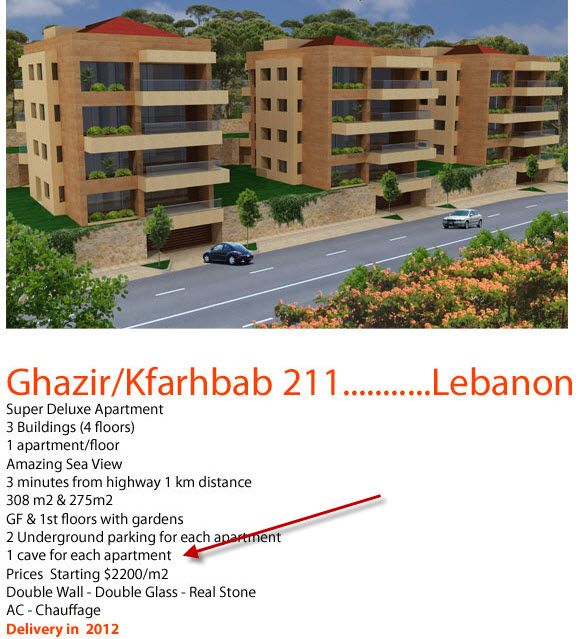
Brighftox has customers around the world so we often see different methods of marketing new projects which are geographically specific. This morning I received the below email promoting a luxury project in Lebanon. Quite large floor plates, see views and all in all pretty good sounding apartments. Then I saw the most important inclusion of all – 1 cave for each apartment!
I can only assume that this is a bunker and that in itself is a reminder of life in Lebanon and the ever-present security risks of the region.
Nevertheless, it is amusing to read it in an advertisement.
 Brightfox - What's hot in I.T. for the Property Industry
You must be logged in to post a comment.