Using QR codes in real estate

If you live outside of Japan and don’t know about QR code you are not alone. They are effectively a new form of the standard bar codes that we all see at supermarkets everyday. The essential difference is that a QR code can contain a lot more information than a standard barcode and it has evolved into main stream use.

In Japan you will see QR code on posters, magazines, bus timetables, busines cards and so on. So what do they look like and how are they used?

Here is our Brightfox QR code

QR Code for Brightfox

If you had a QR code reader, this image would tell you one thing – namely our website address – www.brightfox.com.au

So if you have a QR code reader on your mobile phone you can simply take a picture of the above QR code and your phone will then popup our website address and a prompt as to whether you would like to visit the wesbite. Pretty cool I think you would agree.

So what possible uses does this technology have in the real estate sector?

Here are a few ideas that we are working on here at Brightfox:

– insert the QR code on signage so that a prospect can be taken direct to the property or project website. This is particularly useful if you have a mobile phone ready website. Prospects can be standing outside a home and be browsing images and descriptions immediately.

– place a QR code on your business card. This is particularly beneficial if you are doing business in Asia as it provides an easy means to grab your essential details.

– use a QR code in advertising, whether in newspapers or magazines. For example, why not insert a QR code into advertisements for First Home Buyers that takes them to a unique website that enables them to register for a special offer. You capture the prospects details and hit the target audience with a technical wow that really makes you stand out.

If you would like to learn more about QR code and how you can use them in promoting property, give us a call.

Why does every property developer need to systemise their business?

Your project has just hit an important stage in its development.  Your organisation is frantically producing construction updates, contacting prospects, organising advertising campaigns and trying to find where all the pre-sales enquiries were filed.  At the end of the day, the job gets done.  But could it have been done better?

 Undoubtedly, the property development and project marketing industries are founded on sales.  Usually, the sales and marketing process differs little from project to project.  However, in our industry experience we have found that sales and marketing are the least systemized processes of the whole enterprise!

Many property development and project marketing companies rely on the methods of each of their sales people to produce results.  The result is usually mayhem.  The company no longer presents a uniform, professional image to their clients and increases the risk of breakdown in the sales and administrative chain.  If you want to produce consistent and ultimately more profitable results, a system is essential to close the gap between the varying skills of your people and the skills your business needs to be the very best. 

Those developers and marketers that employ a systemized sales and marketing process equip themselves with the tools to produce results in the most efficient and profitable manner.  By utilising systemization, developers are better able to manage their resources to accomplish a project within a given time and cost restraint.  Furthermore, they optimize the use of those resources such as time, capital and manpower over the course of a project.

With technology changing the way developments are sold, most companies now cannot function without some degree of technological systemization or risk being left behind.  However, this topic does cause some concern for some developers due to the early industry producing technology that hindered rather than improved business processes.  By working in conjunction with the property industry, there is now systemized software that is designed to better align technology with the property development methodology.  Ensure that whatever software you choose to help with your systemization strategy, it must be able to customize your particular organization’s business processes.

If you want to reduce human error and make business tasks simpler and easier, it is software that can automate certain business activities.  We shall look into some of the ways that technological systemization can be employed in your business:


Contact Management, Lead Generation, Client Service

Applying a centralized system to the care and management of clients can have a dramatic and measurable impact on the developers and project marketer’s ability to grow.  In our experience, we have found that many developers and project marketers use systems such as spreadsheets with the names of clients, their contact information and any particular notes and activities pertaining to them.  However, as they grow and demands increase, spreadsheets can end up limiting the organisation’s potential. Spreadsheets are a way to capture information but do not enable you to analyse the information in a meaningful way.  They also do not allow to you create diarized activities and tasks relating to that information.

It is beneficial to use a software system that can combine customer relationship management (CRM) software and sales automation for your client database.  The best way to manage a prospect is to create an activity plan that is automatically generated for a contact.  For example:


Prospect

Activities

Time
Hot Prospect Subscribe to monthly newsletterSend information pack

Follow up call

Send email

Follow up call

Default system settings

1 day

2 days from initial contact

5 days from initial contact

1 week from initial contact

Warm Prospect

Subscribe to monthly newsletter

Send information pack

Follow up call

Send email

Follow up call

Default system settings

1 week

1 week from initial contact

2 weeks from initial contact

1 month from initial contact

Cold Prospect

Subscribe to monthly newsletter

Follow up call

Send email

Follow up call

Default system settings

2 weeks from initial contact

1 month from initial contact

Every 6 months

The software should be able to prompt your salespeople through these processes, and in some cases conduct some of these tasks automatically on behalf of the salesperson, such as sending ‘thank you’ emails. 

The system should ensure consistency in the capture and storing of client information as well as your company’s response to them.  This is relevant both for sales optimization, business reporting, as well as tracking the activities of your sales team and their relative success or otherwise.  Through the information captured, you can further identify and respond to the evolving needs and wants of your clients by using the information to constantly review your processes, and thereby making your organization increasingly effective. 

Technological systemization can assist in creating a consistent brand image that you present to your clients.  Setup professional html email templates and mail merge templates for your staff to use.  Having high-quality email and mail merge templates enables you to automate your communication, for example your software can send out automatic ‘thank you emails’ on behalf of a salesperson.

Have diarised tasks with automated prompts to ensure you send out weekly or monthly email newsletters regarding your company and/or specific project.  Integrate a response tracking system to help you automatically measure the results of your campaign. 


Marketing and Advertising

At the beginning of each project, a property developer or project marketing organisation should set out clear goals and methods of analysis for their sales and marketing process.  Without these methods, they subject themselves to ‘reactive marketing’ – it’s like travelling without a map.  In our work with property developers and real estate agents, we tend to find the same major problems arise again and again. 

  • The first issue: is your marketing working successfully?

Many developers and agents tend to use the old adage “Half of my marketing works; I just don’t know which half!”

How do you confront this?  An effective CRM system can enable you to track the cost of your lead generation and cost of sale.  The systematic capture of contact data and tracking of marketing campaigns enable you to review the success or failure of your marketing.  For example: if you receive 20 enquiries from your newspaper advertisement but none result in a sale, and only 5 enquiries from the internet but 4 result in a purchase – where are you going to concentrate?

  • The second issue: mismanagement of the advertising placement process. 

Many organisations encounter difficulties when trying to keep to their media schedule.  Using software to systemize this process can be a valuable tool when keeping to your media schedule.  Some systems can prompt your staff through a step by step process for advertising strategies – such as approval requests and updates.  The more automatic your system is designed to produce a marketing result, the more effective your sales will be. 


Stock control

Having a centralized system for your stock control is essential when selling a project.  This enables you to track each property and gives your sales staff access to live stock availability.  We find that out of date systems or spreadsheets are flawed in this regard, resulting not only in reduced customer service but can also create legal ramifications. 

While systemizing your marketing processes ensures a consistent professional image, it can also reduce sales and administrative error.  Sending out the wrong brochure can be a nuisance but if a salesperson does not have the updated price list it can leave you open to litigation.  You should not only keep your important documents in a centralised system that your staff can access, but you can also systemize your communication with your staff such as sending out automated emails when a price changes on a property or a construction update occurs.


Contract Administration

In property development and real estate offices around Australia, there are thousands of people involved in the day to day activities related to contract administration.  Most of them manage the same process – what letters need to go out, which people to notify when finance is due or settlement due.  However while this is one of the most important areas of the business, it is also the one that is most fraught with error.  If you are looking into systemizing your business processes, contract administration should be a primary focus.

For example, we find that a common problem is when a property is on hold for seven days, and then forgotten to be released back into the stock list for sale and agents are not advised.  A software program that can systemize your contract administration can automatically prompt your staff through the specific processes, such as emailing the salesperson and contract administrator to remind them when finance is due.  This reduces the risk of mismanagement, contract fallovers and missed sales opportunities. 


The way of the future

Ideally, through technological systemization, you should integrate all these elements required to make your business work.  Not only will you create a more efficient and successful enterprise, but it will also change your organization from one that is reliant on key staff skills, to one that can run smoothly throughout the years and subsequent staff turnover.  I’d like to quote Michael Gerber, the author of ‘The E-Myth’ – a bestselling book that focuses on the importance of business systemization: “Most businesses fail to fully achieve their potential. That’s because the person who owns the business doesn’t truly know how to build a company that works without him or her—which is the key.”

How to run effective email marketing campaigns?

Email marketing can be such an effective marketing medium, but all to often customers emails end up as SPAM. So what do you need to do to make sure you next email is one of the effective ones, and not one of those marked as SPAM! Below we have a few simple but essential tips on how to make your next email campaign a success.

First of all lets talk about SPAM. There are some pretty scary statistics about the level of SPAM email in the world today. In fact in a report published in mid 2008 by one of the world’s largest anti-spam firms (Sophos) they reported that only 1 in 28 emails are legitimate (the rest are Spam). Given the rate at which email and spam is increasing, we can assume it is even worse by now. Interestingly the worst two countries for spam origination were the US and Russia. Australia, New Zealand and all GCC countries were not in the top ten.

So what are the steps to ensuring your next campaign is not marked as SPAM.

Rule 1. Ensure you email to a targeted list of recipients only.

There are two ways your email can be marked as SPAM. The first occurs automatically. Ant-spam software scans your email and if it thinks it is SPAM, it will either delete it completely or at least mark it as SPAM. The second is that someones receives your email and then reports you and your email to an ISP or Anti-Spam firm, which can also result in not only the single email campaign, but also all email from you domain name being marked as SPAM.

So the first rule is only send your bulk emails to people who have requested it. If you send bulk emails to unsolicited lists, you email will be marked as SPAM and you may even get Blacklisted (all email from your domain name will be marked as SPAM automatically). 

Rule 2. Personalise your email.

If you reach the recipients Inbox, the next key is to ensure that they read it. The best way to do this is to personalise the content of the email. Now you may immediately think that this means addressing the email to them personally. Yes this is valuable, but the single most important thing is to ensure that the content they receive is relevant to them. A personalised email promoting a new car will not be relevant nor appreciated by someone who contact you enquiring about property for sale.

In terms of property, this means sending relevant property content. If someone has enquired on 2 bedroom apartments for investment, don’t send them luxury waterfront villa’s. No matter how you address the email, this is bad for business. It won’t get you enquiries, but it will get you unsubscribes.

Emailing non-relevant content and offers to your database can be one of the fastest ways to kill your valuable database.

We recommend recording prospects buyer matching criteria and sending only relevant information to each prospect. Our two CRM products, foxEnterprise and foxAdvantage, can do both with ease so this shouldn’t be too hard to implement.

Rule 3. Always use a relevant but still catchy Subject Line.

In my view this can be the hardest rule to follow. As we all know, we scan our email often quickly, scanning the subject line and making a decision then and there as to whether to read or delete. That split second is often the determining factor in a successful campaign or otherwise.

The hard part is making your Subject Line cut through all of the other emails your recipients get, but not going over the top so that your email gets marked or is viewed as SPAM.

Here is a small sample of words you should NOT use in your subject line:

  • Free
  • Discount
  • Opportunity
  • Click here
  • Call Now
  • Amazing
  • Make Money
  • Eliminate Debt
  • Winning
  • Credit
  • Loans
  • Order Now
  • Special Offer
  • Cash Offer
  • Going fast
  • etc

Pretty much any derivatives of the above are going to also be highly dubious. Also don’t add in explanation marks, question marks and any punctuation, as this will also affect your SPAM rating.

So what is a good subject line?

As with the email itself, it needs to be relevant. So ideally your subject line will immediately identify to the recipient why your email is relevant to them, and hence why they should open it.

So in the example above where we have a prospect wanting a 2 bedroom apartment for investment. The ideal subject line may be: – New 2 bed apartment ideal for investors.

This hits all of the hot points the prospect needs, namely ‘new’ (something they have not seen and also creates the opportunity to get in first), ‘2 bed apartment’ (the right product – so they are not wasting time looking at non-relevant properties) and ‘investment’ (once again relevant product).

So if your prospect got this email, and providing the email itself was sent to a targeted and relevant list, I would think that you would get a high % of opens (the emails are read).

This is an easy example but unfortunately writing subject lines is pretty hard work. So the best idea if you have time to to run trial campaigns. Come up with 2 or 3 different subject lines and use them to different sample groups and measure their effectiveness. There is no metric better than the number of email responses or phone calls that you get from each one to tel you what is working and what isn’t.

Rule 4. Update your CRM software religiously.

Once your mailing lists are out of date, then your emails will start loosing relevancy and their effectiveness will drop rapidly. If you are serious about email marketing you need to ensure your house in always in order – which in this case means your CRM is always up to date.

Buyers Flocking back to property markets. It’s been a while since I have seen a headline like this!

This is an article I read today in the Illawarra Mercury. It made me smile as it has been a while since we have seen these types of articles.

Excuse me for being a pessimist, but I might just wait until I start celebrating the start of the next property cycle (when property prices will start rising again). I think the best that we can hope for at the moment is that the market has stabilised. If so then buyers will come back. I believe that we are getting close to that point now. With interest rate falls and a stabilisation in the stock market, with overall economic conditions are far less erratic than last year, I can see buyers entering the market with enough confidence to take action (purchase).

The real risk in our economy now are further macro-economic events from the world economy. Another Leahman Brothers or , more likely in my view, a geo-political event in any of the developing world, must still be rated as being of significant risk. I have not seen any recent surveys on business confidence, but I would be guessing that it would only have slight improvements so far. I think we need a few more solid month’s under our belt before business confidence can start to rebuild. In the property context, this means less supply of new land, houses and apartments.

I can really see a unique environment developing in the property sector. The low interest rates and first-buyer grants will continue to produce demand for property in this sector. The very poor economic environment world wide, with the resulting poor confidence and lack of readily available finance, will result is significantly reduced supply of new properties. The two obviously don’t sit well together. So the great irony will be that at this stage those developers who do have suitable stock available or in the pipeline, and who have managed to sort their finances, there is probably the potential for price increases in the near future.

http://www.illawarramercury.com.au/news/local/news/general/buyers-flocking-back-to-property-markets/1427851.aspx?src=rss

RBA & the Government – so out of touch!

I read today the Reserve Banks latest Statement on Monetary Policy and also most chocked on my water (I have recently given up coffee!).

Here is an excerpt from the Statement:

“Short-term indicators of housing construction suggest that activity weakened late last year, and there were modest declines in aggregate house prices. Nonetheless, prospects for the year ahead should be supported by the significant declines in interest rates that have occurred, along with the increase in the first home owners’ grant announced in October. A recent pick-up in housing loan approvals and in reported display home traffic suggests that these factors are now starting to add to housing demand.”

To read this it sounds like the property sector is in a slight downturn and that things are now looking up. Seriously, who are these guys talking to! If they would talk to any real estate agent or developer who is on the ground they would tell them how tough things really are. A pick up in traffic to onsite displays from 0 to a couple a week for anyone (other than those selling to First Home Buyers) is hardly cause for optimism.

Unfortunately the Government hasn’t really figured it out either. Their plan is to spend money. In fact it is the same plan we all have had for the past decade or so – spend money. The Government is now replicating the exact same thing that consumers have done for the past decade and more that got us into this problem in the first place…. that is, spending more than we earn. Effectively financing our lifestyles on credit.

At the time of course we all thought that our increased spending was not financed by credit, but by increases in asset prices. So as our homes and shares increased in value, we borrowed more money as we believed we had it, to spend more. Sometimes on other assets (thereby pushing up asset values further), and a lot on discretionary items. The problem is now is that our assets are not worth what we thought they were. So what we were spending wasn’t our money at all as whilst out asset values have dropped, unfortunately, our debt levels haven’t. So in effect we were spending the bank’s money. No different to a credit card really when you look at it like this, and credit card’s have to be repaid at some stage don’t they?

So what is the Government doing now? Pretty much the same thing. Spending money that it doesn’t have based upon what? ….. future revenue which will be predominently funded from what? ….. commodity revenues! So the Government is going to spend Billions of dollars of our money on the hope that Commodity Prices will once again boom and our economies fortune will turn around.

Well my question is… what if it doesn’t? What if commodity prices remained subdued for 3 years or even 5. What happens then? I don’t hear anyone talking about that. Are we going to spend $50 Billion each year to try and shore up the economy for the next 5 years? People talk about leaving a legacy for our children. Now that would be a legacy worth talking about!

What should we be doing? I don’t purport to be an expert but surely we need to focus on productivity improvements. Surely we need to bring back into balance our society so that we generate more than what we spend … excluding digging stuff out of the ground. You see the emergence of China, India and the other emerging markets of Asia and Latin America have all breed huge inefficiencies into Western Economies. You tell me how it can be efficient to pay Wall Street brokers millions for retention bonuses (eg Merill Lynch) when they almost drove the company into the ground, and there are no other jobs to go to anyway. How can it be efficient to pay grounds people at schools in mining communities $150,000 salary? Not that I think it is great that they can earn it, but how can that be classed as efficient. We have all been lulled into a sense of security that by exporting our manufacturing and other labour intensive jobs to developing nations we have begun efficient. Certainly this has improved efficiencies. Certainly we all work harder. But 0 elasticity in employment, asset bubbles and high commodity prices have not been conducive to productivity improvements within our own workforce.

So we should be offering incentives to businesses to retool, upskill, employ. We should be spending our money on big ticket assets that will produce productivity benefits for years to come, such as new and upgraded ports, hydro-electric schemes like the Snowy River and improved rail. We should be helping our exporters in every way we can (and not just mineral exports).

We shouldn’t be doing cash handouts. We should be providing tax benefits and other incentives for businesses and individuals to invest in anything that delivers productivity enhancements.

The global internet audience surpasses 1 billion

According to Comscore, a company that measures pretty much anything digital, the world now has over 1 billion internet users, with China being the country with the most users. as you can see in the below stat’s, the largest number of users are in the Asia Pacific region (which includes Australia).


Total Worldwide Internet Audience: Regional Breakdown

Ranked by Total Unique Visitors (000)*

December 2008

Age 15+, Home & Work Locations

Source: comScore World Metrix

Region

Total Unique Visitors (000)

Share of Total Worldwide Internet Audience (%)

Worldwide

1,007,730

100.0%

Asia Pacific

416,281

41.3%

Europe

282,651

28.0%

North America

185,109

18.4%

Latin America

74,906

7.4%

Middle East & Africa

48,783

4.8%

China represents the vast majority of these users, and will continue to do so into the future as the % of internet users in that country continue to increase. Japan, India and South Korea also feature in the top countries.

You can find the full article here – http://www.comscore.com/press/release.asp?press=2698

What does this mean for property companies around the world? Well most do not currently focus at all on any market other than their immeidate local market. Many do not even look at the entire domestic market let alone the international market. However as capital continues to flow from the western economies to the developing world, it will be essential for leading property firms to establish a solid understanding of these markets, and mechanisms for penetrating them. This means have multi-lingual skills, networks and systems that support international property transactions.

Brightfox is one of the few genuinely international technology firms in the world that focus exclusively on the property industry. With offices in Australia and the UAE, and customers in many countries around the world, we have developed significant experience in assisting our clients open up and do business in a wide diversity of markets. We have also spent many years now customising our software and systems to ensure they meet these specific requirements, which is also very unique.

I suppose the best example of the international focus of our business is the range of languages we speak. They include Arabic, English, Mandarin, Cantonese, Hindi, Portugese, Spanish, Farsi and Sinhala.

Buying homes in the US for $1000 (or less)

I read an interesting article on CNN about purchasing homes for as little as $500 in many cities in the US due to the dire financial circumstances the US is in. You can see the article here – http://money.cnn.com/2009/01/08/real_estate/thousand_dollar_homes/index.htm

So I went to www.realtor.com to check out some of these places for myself. Here is a list of some of the more presentable  $1000 homes I could quickly find in Detroit.

http://www.realtor.com/realestateandhomes-detail/3936-Beniteau-St_Detroit_MI_48214_1105870011

http://www.realtor.com/realestateandhomes-detail/3464-Edison-St_Detroit_MI_48206_1105998133

http://www.realtor.com/realestateandhomes-detail/18368-Bentler-St_Detroit_MI_48219_1105325462

http://www.realtor.com/realestateandhomes-detail/19173-Dresden-St_Detroit_MI_48205_1105799515

Sounds like great value – but there is one catch!

You need to sign an affidavit that you will fix the home up to a habitable state. So you will need to add a little to the prices, however still great value I suppose.

In the past property has always fared some much better than shares in recessions. The basic reasons for this is the fundamental characteristics of the property market – namely it is rather illiquid (homes can not be sold easily such as shares – it takes time and money) and the majority of residential property are people’s homes and not investments, which as a result is one of the last things sold even when times are tough.

The big difference in the US now is that when times are so tough that hanging on to a home is not possible, this impediment to significant price reduction is removed. So whilst property is still illiquid as compared to shares, in markets such as the US it is suffering price depreciation at least as significant as the share market.

In Australia and the UAE (where we have offices), the drop in the share price has still superseded property price falls, at least for the time being, and given that both economies are genuinely sound, this should continue to be the case in my view.

Press Release from UDIA Qld to prevent job losses in the property sector

Below is a press release from the UDIA (QLD) Branch – urging immediate state and federal government action to assist the development industry.


29 January 2009

MEDIA RELEASE


Queensland development industry issues SOS


The peak body representing the development industry in Queensland, the Urban Development Institute of Australia (Qld), has today (29 January) issued an urgent call to the Queensland Premier and the Prime Minister to prevent further job losses in the once-thriving housing sector.


Various industry indicators, including job losses across the sector of up to 30% (in many development companies) and a decline in interstate migration, are now pointing to a massive disruption and the potential devastation of the housing and construction industry.


UDIA Queensland President Brett Gillan called on Premier Anna Bligh to ensure that infrastructure funding received from the proposed federal economic stimulus package would create jobs and provide much needed aid for Queensland’s housing and construction sector.


Mr Gillan said there have been numerous job losses in Queensland’s development industry during the last four months with many corporations reducing staff by up to 30%.


“To date project staff, acquisitions officers and support staff have been the primary areas in which job losses have occurred,” Mr Gillan said.


“Given the diverse nature of the industry make-up, it is impossible to put a figure on exact losses to date but the cancer is spreading to architects, design and planning staff, as well as the building trades.


“Not only is this personally distressing for all of those involved it presents a difficulty for the future in that development sites are not being generated for the pipeline in the 3 – 5 year time frame.


“Further, due to the current cost structure and reduced prices for existing housing, demand is strongest for market-entry housing.


“On this basis, there will clearly be significant demand for entry level housing for the next 3 – 5 years as many existing householders retain there existing homes and choose not to upgrade.


“This means that there will need to be a major reversal of policy by the Queensland government with respect to the charging of infrastructure charges for new home purchasers if Queensland’s industry is to recover from the current economic down turn.


“The writing is clearly on the wall.


“Victoria’s housing industry is not ailing because it has retained attractiveness for first home purchasers.


“The New South Wales Government has finally recognised that the only way to stimulate their failed development industry has been to abandon the controversial user pays charging mechanism that imposed 100% of the burden of the new infrastructure of new home purchasers and return to a model that has worked successfully in Australia for the last 100 years (and which is currently employed in Victoria).


“The Premier should carefully look at the migration figures from Victoria to Queensland as the tide has turned now after many years of predictable growth.


“The latest ABS figures show only 23,085 net interstate migrants to Queensland in 07-08, down from 37,984 in 02-03.


“Queensland interstate migration is now well below the state government projections of 31,500 for 07-08.


“Any funding for major construction should not only address future major infrastructure but the housing sector as well.


“The government should also be conscious that the level of funds currently being provided for the implementation of major state-wide infrastructure is placing massive burdens on the providers of major infrastructure already. It is essential that any funds spent on infrastructure are directed towards areas that will see major employment gains across the board.


“The housing market is one such area where new development sites and affordable housing construction would very rapidly employ many hundreds of people.


“The development industry strongly suggests to the Premier that funds are used to assist Queensland local authorities to provide major infrastructure, particularly related to the distributions of water, local roads, and sewerage treatment facilities in the growth areas where development is likely to occur in the next 3-5 years.


“Infrastructure-led development such as this will, in conjunction with an immediate cap on increases for infrastructure charges throughout Queensland, assist in breathing life into the dreams of first home owners.


“At the same time there needs to be a subsidisation process for those local authorities that already have excessive infrastructure charges to enable development of properties to proceed at a more affordable level.


“These are unprecedented times and the solutions require a comprehensive knowledge of the economic impacts of the housing, construction and development industries.


“Land taxes, stamp duty, GST, infrastructure charges, transfer duty, mortgage duty and a host of other government taxes and charges as well as the flow on effects of company tax and personal income tax are lost when thousands of workers in housing construction are made redundant.


“With declining workloads, the impact of the recession is now starting to bite in the provision of trades and this will in turn affect staff in suppliers, hardware stores, plumbing supplies, electrical supplies and so on.


“The time to act is now in view of substantial job losses to date as well as in anticipation that these losses of jobs will continue to occur rather than trying to put a bandaid solution on far too late.


“Responsible actions need to be swift and pre-emptive rather than waiting for the crisis as we have seen occur in the mining industry in recent weeks and in the provision of many other services in the past.


“Bringing forward spending on existing capital works projects is only part of the solution. We need to kick-start ailing sectors rather than only focussing on major works,” he said.


End.


Media: For more information, please contact Susan McCosker on 0422 567 667.

Shift in focus from transcation sales to outbound sales

It is tough out their!

With the state of the real estate markets around the world, I don’t think there is any single marketplace that is not experiencing reduced enquiry rates and as a consequence, sales rates. Which ever way we look at it, this is effecting property businesses underlying profitability.

I was recently discussing this with one of our clients, and put forward a suggestion that I want to share with you today. That suggestion is to change the culture of your organisation from sales transacting to outbound sales.

So what does this mean?

Sales transacting is is culture of effectively waiting for the prospect to make the purchase. Your sales team is entirely reactive. They wait for a prospect to enquire, and often wait for them to purchase, and then effectively take on a role of facilitating the transaction. This sales transacting role can also be described as  ‘order taking’. This culture is really born out of bull markets. When times are good, and a new prospect is around every corner, your sales team really only needs to focus on sales transacting to make target, and a very acceptable living.  However this is a very poor sales culture, if we can call it sales at all. At best it can be described as a sales administration role, at worst simply an administration role full stop.

So what is an outbound sales culture? That is where your sales people are proactively chasing prospects. They are hunting for business, rather than order processing.

It goes without saying that is a slowing (slow!) market, you need your sales people busy. They need to be proactive and to be chasing every opportunity and can not be waiting for the next purchaser to walk in.

How do you create this type of culture?

Here are just a few ideas:

– break the mold. You really need to confront your sales team and get them to understand that things are different. The market has moved, and they need to move with it or they will be pushed out of the property industry. You need to make clear to them that the ‘new’ corporate culture of your organisation is about ‘outbound sales orientation’.

– give them the tools.

– systemise, systemise and systemise. When your business is effectively processing deals, you don’t tend to need to many systems. You can afford to operate inefficiently simply because they are good times and plenty of profit to go round. However in tougher times you need your business running like a well drilled team and it is systems that will achieve this. If you don’t have paper based systems – put them in. Better still though get effective software to manage, control and report on the key aspects of your business so you are operating as efficiently as possible.

There is never a better time to drive real change in your business then when times are tough. Everyone, from your board through to your sales people are all concerned about revenue and profitability, so now is the perfect time to effect that change in your business.

Just how bad can it get in the US?

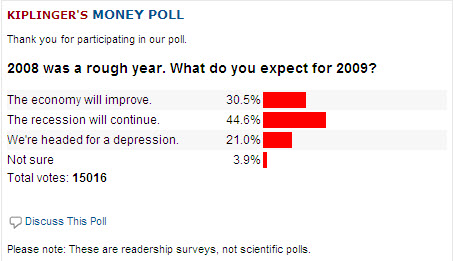
Kiplinger.com Survey Poll

I think this is what we are all wondering at the moment?  Will the US economy get worse, pulling the world along for the ride, or will it start to recover in 2009?

I saw this very interesting online survey at US personal finance magazine website www.kiplinger.com. I thought the investor sentiment was poor in the US, however these results really surprised me. With a sample of over 15,000 this is a reasonable assessment of investor opinion, whilst being obviously unmonitored for complete accuracy.